Most teams do not lose productivity because people are unwilling to work harder. They lose productivity because work becomes harder to see, harder to sequence, and harder to adjust once priorities begin to shift.
A project may begin with a clean roadmap, but within a few cycles, reality changes. Tasks expand, dependencies appear, one team moves faster than another, and managers begin asking for updates that already exist in multiple places. At that point, productivity is no longer limited by execution alone. It is limited by how intelligently work is being managed.
This is why project management systems are changing. Teams no longer need tools that simply record tasks. They need systems that help them plan with context, move work through clear workflows, and generate live visibility while work is still happening.
Zymmr is built around this shift. As an AI-driven, low-code project management platform, it connects planning, execution, tracking, and reporting in one working environment, so teams can manage work with more clarity and far less operational friction. That is where intelligent project management begins to improve real team output.
Productivity Improves When Planning Reflects Real Capacity

A large number of project delays begin before execution starts.
Teams often plan work based on broad estimates, available deadlines, or optimistic assumptions. But planned effort and actual effort rarely match perfectly, especially when multiple contributors, dependencies, and review cycles are involved.
This is where intelligent planning changes outcomes.
Zymmr improves planning by combining sprint setup, work estimation, and capacity visibility in one system. Before a sprint begins, teams can define available capacity for each contributor and view how much work is already allocated. This immediately shows whether workloads are balanced or if someone is already overcommitted.
The platform also highlights overallocation visually, which helps managers intervene before work begins slipping. Instead of discovering overload halfway through a sprint, teams can rebalance earlier.
This matters because realistic planning protects delivery rhythm. Teams commit more accurately when capacity is visible before work starts.
- Task Automation AI can handle repetitive activities like assigning tasks, sending reminders, or updating progress reports.
- Smart Suggestions AI algorithms analyze project data to suggest optimal workflows, helping you save time and effort.
- Reduced Manual Errors Automation ensures fewer human mistakes, leading to smoother operations.
Structured Workflows Reduce Hidden Friction

Many teams believe productivity drops because people are delayed in completing tasks. In practice, productivity often drops between tasks, when work changes hands without enough clarity. A task may move from development to review, then wait because ownership is unclear. Status updates may sit in one tool while discussions happen elsewhere. Teams spend time asking where work stands instead of progressing it.
Structured workflows reduce that hidden friction.
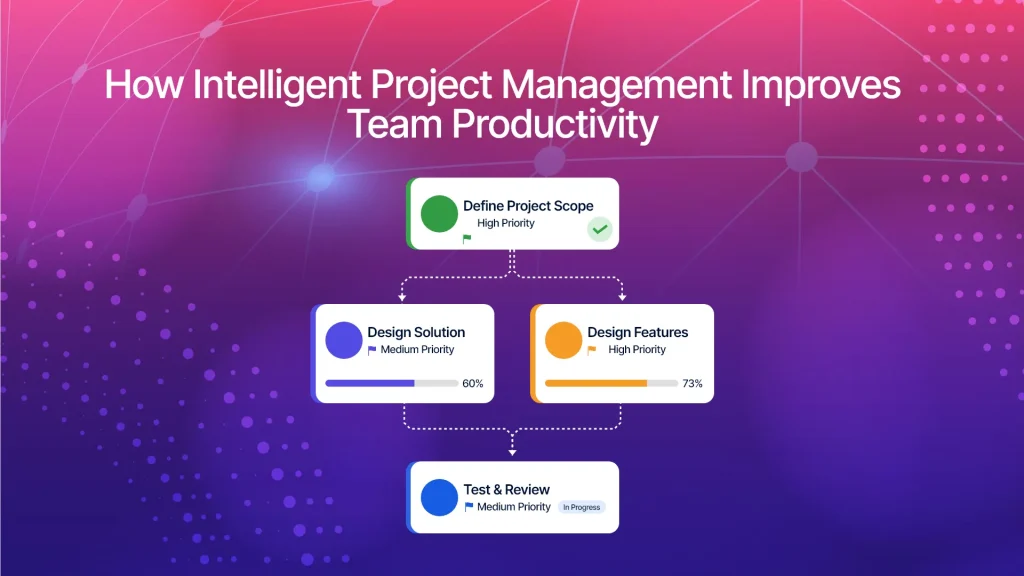
In Zymmr, every WorkItem moves through defined workflow states such as New, In Progress, Done, or custom transitions created by the organization. Because workflows are visible through status transitions, every contributor understands what stage work is in and what the next action is.
For Agile teams, this becomes even more practical through Kanban boards and sprint boards. Teams can see active work, pending tasks, bottlenecks, and ownership in one shared visual system. This reduces one of the most common sources of productivity loss: uncertainty between teams.
Real-Time Reporting Removes the Delay Between Work and Decision-Making

Many project teams still rely on delayed reporting. Progress is reviewed in meetings, spreadsheets, or status summaries after work has already moved. By then, small delivery risks are often larger than they appear.
Real-time visibility changes this because teams do not need to wait for reporting cycles to understand project health.
Zymmr’s Active Sprint Board gives teams a live view of tasks, assignees, and sprint movement as work progresses. Combined with auto-save field updates, changes happen immediately without requiring separate manual reporting.
This means that when a task remains blocked, exceeds estimated effort, or stays in review longer than expected, that signal becomes visible early. Managers can act while there is still time to recover delivery, not after deadlines are already affected. That is where productivity improves most, when visibility shortens the distance between work and decision-making.
AI Matters Most When It Helps Teams See Patterns Early

AI in project management is often described in broad terms, but its most useful role is simple: helping teams identify patterns that humans usually notice too late.
Across projects, teams generate useful signals every day. Certain tasks repeatedly exceed estimates. Specific stages slow down often. Similar dependencies create delays across multiple sprints. Without intelligent analysis, this data remains buried inside completed work.
Zymmr’s AI-driven project intelligence is built to make this operational data useful. Instead of only tracking tasks, the platform helps teams read patterns across delivery behavior and planning accuracy.
This supports better sprint forecasting, stronger workload planning, and earlier course correction. AI becomes valuable when it helps teams improve the next cycle, not just explain the previous one.
Why Productivity Improves When Fewer Tools Are Involved

One major reason teams lose time is tool fragmentation.
Planning may happen in one platform, updates in another, and effort tracking in separate spreadsheets. Every handoff creates small delays.
Zymmr reduces this by connecting work updates, comments, assignments, and time logging within the same project environment. A WorkItem can be updated, commented on, assigned, and time logged without leaving the same working context. Team members can mention others directly inside comments, ensuring that communication stays attached to the task itself.
Time logging also adds practical value. Teams can record actual effort by work type, date, and comments, making future planning more grounded in delivery reality.
This turns productivity into something measurable rather than assumed.
Turning Intelligent Project Management into Practical Delivery
The strongest project environments are not the ones with the most features. They are the ones where planning is realistic, workflows are visible, reporting is immediate, and teams can adapt without creating operational overhead.
That is what intelligent project management should deliver.
Zymmr is built to bring exactly that — helping teams streamline Agile workflows, structure sprints effectively, and gain real-time visibility into progress without added complexity.
If your teams are working hard but still facing missed estimates, fragmented updates, or delayed decisions, the opportunity may not be more effort. It may be better project intelligence.
Try Zymmr and experience smarter project delivery. Book a demo today.